Sermorelin vs HGH: a signal, or the hormone itself
Sermorelin prompts your pituitary to release its own growth hormone. HGH is growth hormone itself. They haven’t been compared head to head in healthy adults.
In short
- Sermorelin is a nightly injection that prompts your pituitary to release its own growth hormone, while HGH is growth hormone itself, injected.
- HGH is FDA-approved for specific medical conditions, but there’s no FDA-approved sermorelin today, and using it in adults is off-label.
- In small studies of adults in their 50s to 70s, nightly GHRH raised growth hormone and IGF-1, but no trial has tested sermorelin for energy or recovery, and it hasn’t been compared with HGH in healthy adults.
- Sermorelin isn’t used with active cancer or in drug-tested sport, and a provider checks your bloodwork and decides whether it’s right for you.
How each one acts in your body
Growth hormone comes from the pituitary gland. Your brain tells the pituitary to release it with a signal called growth hormone-releasing hormone (GHRH). Growth hormone then prompts your liver to make IGF-1, which bloodwork uses to track treatment.
Growth hormone release falls with age, by about 14% per decade of adult life in one classic estimate. Your largest pulse usually comes soon after you fall asleep.
Sermorelin is a lab-made copy of the first 29 building blocks of GHRH. A small injection under the skin of your belly at bedtime prompts the pituitary to release a pulse of its own growth hormone. So it depends on a pituitary that can respond, and your body’s usual limits on growth hormone still apply. That’s a difference in how it acts, not a proven safety advantage.
HGH (human growth hormone) is growth hormone itself, injected. It replaces growth hormone directly, rather than asking the pituitary to make more.
| At a glance | Sermorelin | HGH |
|---|---|---|
| What it is | A copy of part of GHRH, the brain’s signal | Growth hormone itself |
| How it acts | Prompts the pituitary to release its own growth hormone | Replaces growth hormone directly |
| How it’s given | A small injection under the skin at bedtime | Injected |
| FDA status | None approved today; approved for children as Geref until 2008 | FDA-approved for specific medical conditions |
| For aging | Off-label, and not shown to slow aging | Federal law bans distributing it as an aging treatment |
| Compared head to head in healthy adults | No | No |
The FDA history
Sermorelin was FDA-approved in 1997 as Geref, to treat children with growth hormone deficiency. Its maker stopped selling it in 2008 for business reasons, and in 2013 the FDA confirmed it wasn’t withdrawn for safety or effectiveness. There’s no FDA-approved sermorelin today. It was never approved for adults, or for sleep, body composition, recovery or aging.
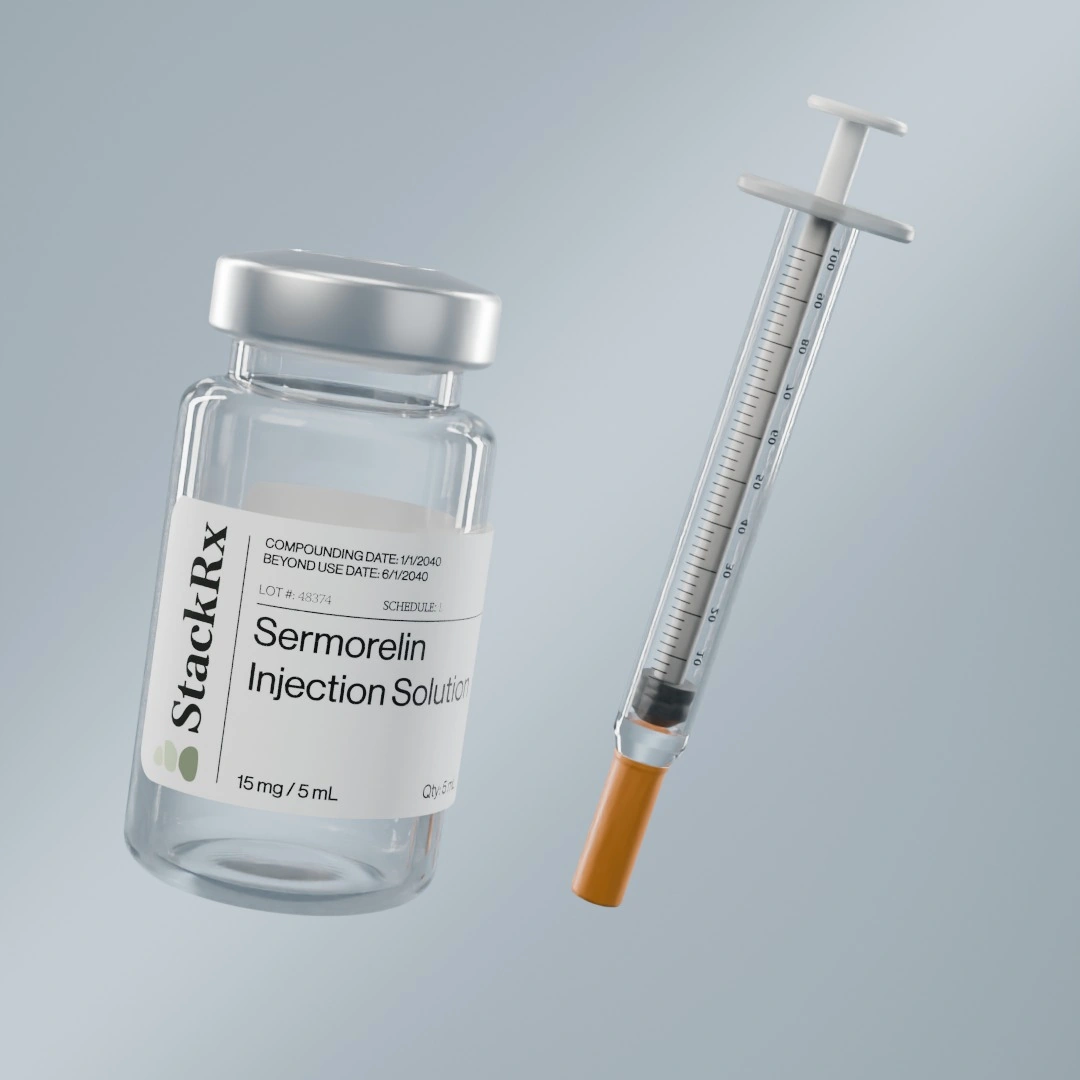
StackRx’s Sermorelin is compounded: a licensed pharmacy prepares it for you individually. The FDA doesn’t review compounded medicines for safety, effectiveness or quality. Using sermorelin for sleep, body composition, recovery or aging is off-label. Read more about compounded vs FDA-approved medicines.
HGH is FDA-approved for specific medical conditions. In adults, growth hormone deficiency is diagnosed with specific stimulation tests and treated by an endocrinologist, usually with FDA-approved growth hormone. Federal law bans distributing HGH as an aging treatment.
What’s known in healthy adults, and what isn’t
Sermorelin. In small studies of adults in their 50s to 70s, nightly GHRH raised growth hormone and IGF-1 within about 2 weeks. In a 16-week study of 19 adults aged 55 to 71, men gained a little lean mass and women didn’t, and skin got slightly thicker. In a 5-month study, body fat fell by about 5% compared with placebo. A 6-week study of 11 older men hinted at more strength. In lab studies, GHRH given at night deepened men’s sleep that night, but it made young women’s sleep lighter.
No trial has tested sermorelin for energy, recovery, sex drive, weight loss or insomnia. The studies were small and lasted months, not years, so long-term safety in healthy adults is unknown. They also used higher doses than are common today, so effects at typical doses are less certain. There’s no evidence it slows aging.
HGH. Given to healthy older adults, growth hormone changed body composition slightly and caused more side effects. In one study, it added lean mass in older men without improving strength or function. That’s why endocrine experts don’t recommend growth hormone treatments for normal aging. Experts also say the evidence doesn’t yet support routine use of GHRH treatments like sermorelin for normal aging.
Side by side. Sermorelin hasn’t been compared head to head with HGH in healthy adults. So it hasn’t been shown to be safer than HGH, or to be as effective.
What a provider checks
StackRx visits aren’t open yet. When they open, a US-licensed provider will review your health, medicines and goals, and prescribe sermorelin only if it’s right for you.
Bloodwork comes first for everyone, before the first vial. The planned panel checks IGF-1, blood sugar (A1c), thyroid (TSH), a blood count and a metabolic panel, plus a morning testosterone test for men. The plan is to recheck IGF-1 and A1c after 2 to 3 months, keeping IGF-1 in the normal range for your age. Higher isn’t better.
Other causes come first too. Your provider looks for things sermorelin wouldn’t fix, such as short sleep, sleep apnea, low testosterone, thyroid problems, blood sugar, medicines and low mood.
A defined trial. If you start, your provider checks in during the first weeks and months. A simple before-and-after rating helps: rate how you feel from 0 to 10 before you begin and again after a few months, and go over it together. If nothing has changed, stopping is a fine result.
Safety and who shouldn’t use it
Side effects
The most common are redness, swelling or soreness where you inject, flushing, headache, dizziness and nausea, usually in the first weeks. Because it raises growth hormone, sermorelin can also cause fluid retention, joint aches, tingling in the fingers and higher blood sugar, especially at higher doses. Tell your care team about any of these. A severe or worsening headache with vision changes needs care the same day. Get emergency care for chest pain, trouble breathing, or swelling of your face, lips or throat.
Cancer and IGF-1
No study has linked sermorelin itself to cancer, but none has lasted long enough to tell. In large studies, people whose own IGF-1 is higher have somewhat higher rates of colorectal, breast and prostate cancer. That’s why sermorelin isn’t used during active cancer, why providers aim to keep IGF-1 in the normal range for your age, and why it’s worth being up to date on cancer screening.
Who shouldn’t use it
- Anyone under 18.
- Anyone pregnant, trying to conceive or breastfeeding.
- Anyone with cancer that’s active or being treated now.
- Anyone with acromegaly, where the body already makes too much growth hormone.
- Anyone who competes in a drug-tested sport. Sermorelin is on the World Anti-Doping Agency’s Prohibited List, banned at all times, in and out of competition.
A provider needs to talk with you first about:
- cancer treatment in the past 5 years
- a pituitary tumor or surgery, head radiation, a serious head injury or diagnosed growth hormone deficiency
- diabetes
- heart, kidney or liver disease
- raised pressure around the brain
- regular steroid medicine
- HGH or another growth hormone peptide, or testosterone, steroids or SARMs without a prescription
- a past reaction to sermorelin, a growth hormone peptide or an injection preservative
- being 18 to 29, since the adult studies were in people 55 and over
Using sermorelin on top of HGH or another growth hormone peptide pushes IGF-1 higher. Above the normal range, that brings side effects like swelling, joint pain and higher blood sugar. See all longevity treatments.
Sources
- Khorram et al., JCEM 1997 (nightly GHRH analog for 16 weeks; 19 adults aged 55 to 71; IGF-1 up within 2 weeks; lean mass up in men; skin thickness up), PubMed 9141536
- University of Washington 5-month GHRH trial in older adults (body fat about 5% lower vs placebo), UW News, 1999
- Vittone et al., Metabolism 1997 (nightly GHRH 1-29 for 6 weeks; 11 older men), PubMed 9005976
- Intranasal GHRH and sleep in young and older men: Perras et al. 1999, PubMed 10451909; systemic GHRH and sleep in healthy young women, 2007, PubMed 17850984
- GH decline by decade: Toogood et al., JCEM 1996, oup.com; GH secretion during sleep: Van Cauter et al. 1996, PubMed 8627466
- GH in healthy older adults, systematic review: Liu et al., Ann Intern Med 2007, doi.org; GH in healthy older men: Papadakis et al., Ann Intern Med 1996, doi.org
- Endotext, Growth Hormone and Aging, NCBI Bookshelf; Endocrine Society, Hormones and Aging, scientific statement 2023, oup.com
- Endocrine Society, adult growth hormone deficiency guideline 2011, oup.com
- Geref not withdrawn for safety or effectiveness, Federal Register, March 4, 2013
- Federal HGH distribution statute, 21 U.S.C. 333(e), Cornell LII
- Sermorelin (Geref) patient information, Mayo Clinic drug information; tesamorelin (Egrifta WR) label, DailyMed; somatropin (Genotropin) label, fda.gov
- IGF-1 and cancer: Knuppel et al., Cancer Res 2020, aacrjournals.org; Larsson et al., Cancer Med 2020, PubMed 32717139; Murphy et al., Ann Oncol 2020, annalsofoncology.org
- WADA Prohibited List (S2.2.4, GHRH and its analogues), wada-ama.org
This article is general information, not medical advice. Only a US-licensed provider who reviews your health can say whether a treatment is right for you. If you have a medical emergency, call 911.