Metformin for prediabetes, PCOS and healthy aging
Metformin is FDA-approved only for type 2 diabetes. Here’s what the evidence shows for three off-label uses, where it stops, and the rules that come with it.
In short
- Metformin is FDA-approved only for type 2 diabetes, so using it for prediabetes, PCOS or healthy aging is off-label.
- The evidence is strongest for prediabetes: in a large trial, metformin lowered the chance of type 2 diabetes by 31%, and a lifestyle program lowered it by 58%.
- Guidelines support it for the metabolic side of PCOS, but no trial has shown that it slows aging.
- Stomach upset is common at first, and because of a rare but serious side effect called lactic acidosis, you need a kidney blood test before starting.
What metformin is, and what it’s approved for
Metformin is a tablet that’s been used for type 2 diabetes for decades. It lowers the amount of sugar your liver releases and helps your body respond to insulin. Type 2 diabetes is its only FDA-approved use.
Providers also prescribe it off-label for prediabetes, insulin resistance and polycystic ovary syndrome (PCOS), and some people take it for healthy aging. Off-label means a provider prescribes it for a use the FDA hasn’t reviewed.
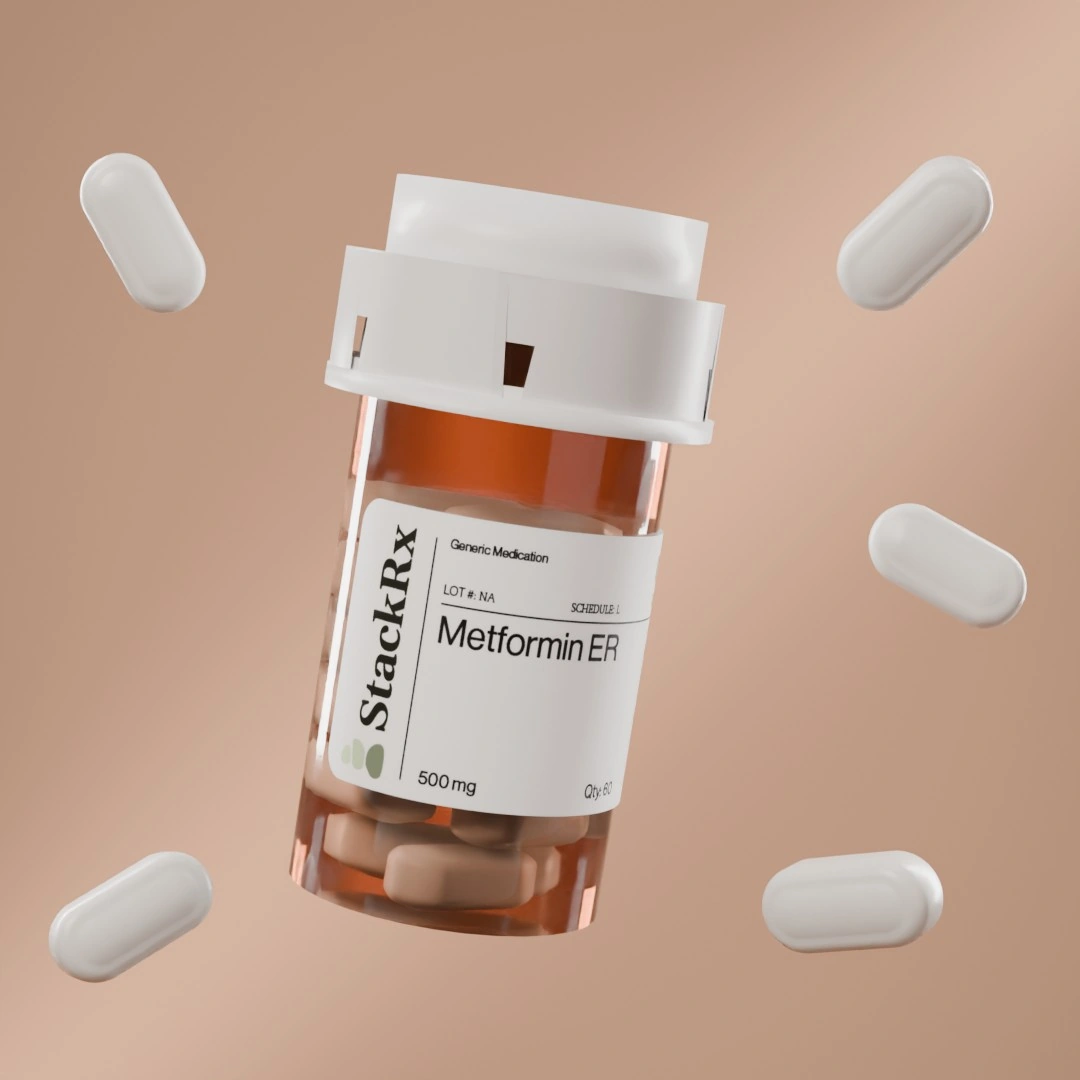
Metformin ER is an FDA-approved generic extended-release tablet, dispensed by a licensed pharmacy as the manufacturer makes it. It isn’t compounded. It comes as 500 mg or 750 mg tablets, taken once a day with your evening meal and swallowed whole. Your provider usually starts at 500 mg and raises the dose slowly over a few weeks. Its label carries a boxed warning about lactic acidosis. For more on the difference, read compounded vs FDA-approved medicines.
What the evidence shows for each use
| Use | FDA status | What the evidence shows |
|---|---|---|
| Type 2 diabetes | Approved | Its approved use |
| Prediabetes | Off-label | Strongest: 31% fewer cases of diabetes than a placebo in a large trial |
| PCOS | Off-label | Guideline support for the metabolic side, mainly at a BMI of 25 or more |
| Weight | Off-label | Small: about 2 kg (5 pounds) on average |
| Healthy aging | Off-label | Unproven: no trial has shown it slows aging |
Prediabetes
The Diabetes Prevention Program followed 3,234 adults with raised blood sugar and extra weight for about 3 years. Metformin, 850 mg twice a day, lowered the chance of type 2 diabetes by 31% compared with a placebo. A lifestyle program, with a 7% weight-loss goal and 150 minutes of activity a week, lowered it by 58%. Fifteen years on, after the placebo group had also been offered lifestyle training, the metformin group still had 18% fewer cases. In women who’d had diabetes during a pregnancy, metformin cut the risk by about 40%.
The American Diabetes Association says to consider metformin for prediabetes, especially at ages 25 to 59 with a BMI of 35 or more, with higher blood sugar, or after diabetes in pregnancy.
Where it stops: over 21 years, metformin didn’t lower heart attacks, strokes or deaths. Only the lifestyle program also lowered the number of chronic diseases people developed, by about a fifth. The trials enrolled people whose blood sugar was already raised, so with a normal A1c the expected benefit is small.
Metformin isn’t a weight-loss drug or a GLP-1. In the prevention trial, people on it lost about 2 kg (5 pounds) on average, against almost nothing on placebo. Some lose more, and many lose none.
PCOS
PCOS often comes with insulin resistance. The 2023 international PCOS guideline says to consider metformin for adults with PCOS and a BMI of 25 or more, to help weight, insulin resistance, blood sugar and cholesterol. It can be considered at a lower BMI, but the evidence is thinner. The guideline rated it more effective than inositol.
Where it stops: metformin isn’t the first treatment for irregular periods, acne or unwanted hair; the combined pill is. For getting pregnant, letrozole is. Some people’s cycles become more regular over a few months, but results vary. Because metformin can make ovulation return, use birth control if you don’t want to get pregnant.
Healthy aging
No trial has shown that metformin slows aging or helps healthy people live longer. TAME, a trial designed to test it in 3,000 people aged 65 to 79, hasn’t reported results.
The idea rests mostly on animal studies and on records of people with diabetes, and those records studies disagree. A large UK study found people with diabetes on metformin outlived similar people without diabetes, but a Danish study using the same method found the opposite. In the prevention trial, metformin didn’t lower deaths over 21 years.
It may also take the edge off exercise. In a trial of 94 healthy adults aged 65 and over doing 14 weeks of strength training, those on metformin gained less muscle than those on a placebo. In another trial, adults around 62 on metformin gained less fitness from 12 weeks of aerobic training. Younger people weren’t tested, and some studies found no effect.
Side effects
Diarrhea, nausea, gas, stomach pain and a metallic taste are the most common, mostly in the first weeks. In trials of the extended-release form, diarrhea affected 10% of people (3% on placebo), and nausea or vomiting 7% (2% on placebo). Starting low, raising the dose slowly and taking it with your evening meal help. A soft mass in your stool that looks like the tablet is its leftover inactive ingredients and is harmless.
Over years, metformin can lower vitamin B12. In the prevention study, low or borderline B12 was about twice as common on metformin after 5 years. Tell your provider about any numbness or tingling in your hands or feet.
Get emergency care for chest pain, trouble breathing, or swelling of your face, lips or throat. Tell your care team about any other side effect.
How a provider decides
StackRx visits aren’t open yet. When they open, a US-licensed provider will review your health history, medicines and allergies, and prescribe metformin only if it’s right for you. You’ll have a kidney blood test (eGFR) before starting and at least once a year after, plus a B12 check from time to time.
Also tell your provider about:
- Liver disease. Metformin is avoided when the liver isn’t working well.
- Heart failure or lung disease that needs oxygen. Low oxygen raises the risk of lactic acidosis.
- Insulin or a sulfonylurea. With metformin, they can lower blood sugar too far, so doses need planning.
- Topiramate, zonisamide or acetazolamide. These can add to the rare risk of lactic acidosis.
- Dolutegravir, cimetidine, ranolazine or vandetanib. These raise metformin levels, so your provider may choose a lower dose.
- Surgery or a scan with contrast dye. You may need to stop metformin for a while and restart once you’re eating and drinking normally or a kidney test is fine.
- Trying to get pregnant, or building muscle or fitness as a main goal.
Safety and who shouldn’t use it
The kidney test
Metformin is cleared by the kidneys, so its label requires a kidney test before the first tablet. It isn’t started when kidney function is too low (an eGFR under 45), and it isn’t used at all under 30. After that, your kidneys are checked at least once a year, and more often at 65 and over.
Lactic acidosis
Lactic acidosis is a dangerous build-up of acid in the blood and the reason for metformin’s boxed warning. It’s rare: a review of trials covering tens of thousands of patient-years found no cases. The risk goes up with kidney problems, heavy drinking, serious illness, dehydration, low oxygen and some procedures.
Stop taking it and get care right away if you:
- feel very weak or tired, or unusually sleepy
- have unusual muscle pain or trouble breathing
- have stomach pain with nausea or vomiting
- feel cold, dizzy or light-headed
Avoid heavy or binge drinking. If you’re vomiting, have diarrhea or can’t keep fluids down, contact your care team, because you may need to pause it.
Who shouldn’t take it
- Type 1 diabetes. That needs your own diabetes team.
- Metabolic acidosis, including diabetic ketoacidosis, or past lactic acidosis.
- A mitochondrial disease such as MELAS.
- Pregnancy. Metformin isn’t started during pregnancy through this service. Your prenatal clinician can advise you.
- An eating disorder, now or in the past year. If you ever feel unsafe, call or text 988.
- A past allergic reaction to metformin.
- Under 18. StackRx is for adults 18 and over.
Sources
- Knowler et al., N Engl J Med 2002 (Diabetes Prevention Program: 3,234 adults, mean 2.8 years; metformin 850 mg twice daily lowered diabetes incidence 31% vs placebo, lifestyle 58%; mean weight loss 2.1 kg vs 0.1 kg on placebo), PubMed 11832527
- Diabetes Prevention Program Research Group, Lancet Diabetes Endocrinol 2015 (15-year follow-up: 18% lower incidence with metformin), PubMed 26377054
- Metformin insights from DPP/DPPOS, Diabetologia 2017 (women with past gestational diabetes: HR 0.59)
- Lee et al., Diabetes Care 2021 (21-year follow-up: all-cause mortality HR 0.99 with metformin), PubMed 34697033; 21-year multimorbidity follow-up, JAMA, June 2026 (lifestyle 21% lower; metformin not significant)
- American Diabetes Association, Standards of Care 2026, section 3 (prevention or delay of diabetes)
- Teede et al., J Clin Endocrinol Metab 2023 (2023 International Evidence-based PCOS Guideline), PubMed 37580314
- American Federation for Aging Research, TAME trial design (planned 3,000 people aged 65 to 79)
- Bannister et al., Diabetes Obes Metab 2014, PubMed 25041462; Keys et al. 2022, PubMed 36287641 (records studies)
- Walton et al., Aging Cell 2019 (MASTERS: 94 adults aged 65 and over, 1,700 mg a day vs placebo during 14 weeks of resistance training), PubMed 31557380
- Konopka et al., Aging Cell 2019 (mean age 62, 12 weeks of aerobic training), PubMed 30548390
- DPPOS vitamin B12, J Clin Endocrinol Metab 2016 (low or borderline B12 19.1% vs 9.5% at 5 years), PubMed 26900641
- Salpeter et al., Cochrane review 2010 (lactic acidosis: no cases in 70,490 patient-years)
- Metformin extended-release prescribing information (FDA-approved use; boxed warning for lactic acidosis; kidney test before starting and at least yearly; contraindications; diarrhea 10% vs 3%, nausea or vomiting 7% vs 2%; interactions; surgery and contrast), DailyMed
This article is general information, not medical advice. Only a US-licensed provider who reviews your health can say whether a treatment is right for you. If you have a medical emergency, call 911.