Low-dose naltrexone (LDN): what the research shows
Some providers prescribe a small daily dose of naltrexone off-label for chronic pain, fibromyalgia and some autoimmune conditions. Here’s what trials found, and where they stop.
In short
- Naltrexone is FDA-approved at 50 mg for alcohol and opioid dependence; low-dose naltrexone (LDN) is a compounded 3 mg capsule prescribed off-label for chronic pain, fibromyalgia and some autoimmune conditions.
- Some small early trials reported benefits, but the two largest fibromyalgia trials and a 2026 Crohn’s trial found no clear benefit on their main measures.
- Vivid dreams and headaches were the most common side effects in trials, and serious ones were rare.
- LDN blocks opioid medicines and can bring on sudden withdrawal, so it isn’t taken with any opioid, and a provider decides whether it’s right for you.
What low-dose naltrexone is
Naltrexone blocks opioid receptors. At its FDA-approved dose of 50 mg, it treats alcohol and opioid dependence and keeps those receptors blocked around the clock.
Low-dose naltrexone uses a small fraction of that, usually 1.5 to 4.5 mg. Researchers think a low dose blocks the receptors only briefly, and that the body may respond by making more of its own endorphins. Lab studies also suggest it may calm immune cells in the brain and spinal cord. Neither idea has been confirmed in people, and a mouse study found its effects may not depend on endorphins.
LDN isn’t an opioid or a painkiller in the usual sense. It doesn’t cause a high, it isn’t habit-forming, and stopping it doesn’t cause withdrawal. At a low dose, it isn’t a treatment for drinking or opioid use; full-dose naltrexone is.
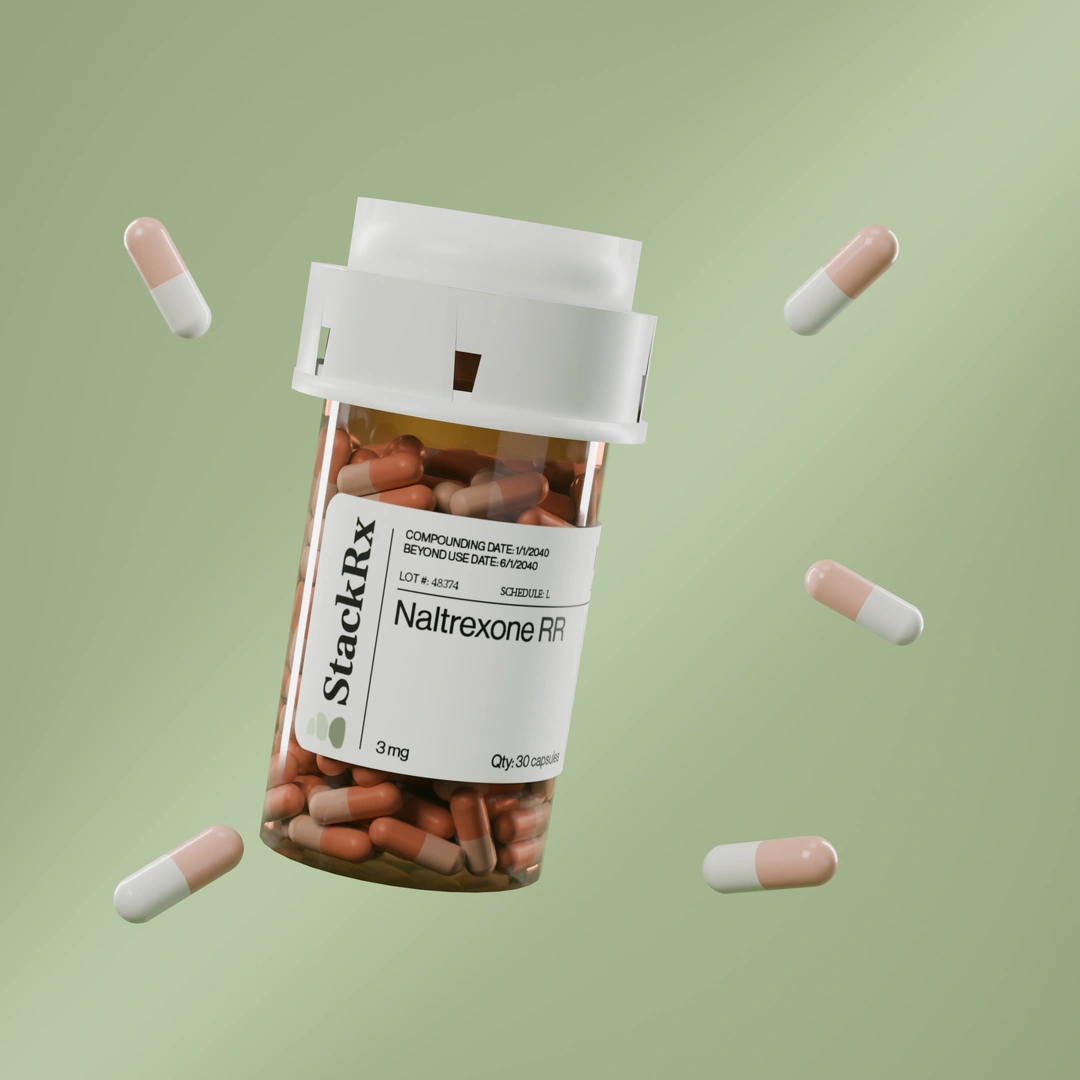
Low-Dose Naltrexone is a 3 mg rapid-release capsule, taken once a day, usually at bedtime. Rapid release, the form used in the published trials, lets out the full dose soon after you swallow it. No study has compared it with slow release.
There’s no FDA-approved low-dose version, so LDN is compounded: a licensed pharmacy prepares it for you individually. The FDA doesn’t review compounded medicines for safety, effectiveness or quality. Using naltrexone for pain or autoimmune conditions is off-label, meaning for a use the FDA hasn’t approved. For more, read compounded vs FDA-approved medicines.
What the research shows, and where it stops
The evidence is mixed. Most trials were small and lasted 8 to 12 weeks.
Fibromyalgia
Fibromyalgia has the most research. In a 2013 US trial of 31 women, daily pain fell by 29% on LDN, against 18% on a placebo. Since then, two larger, carefully run trials found no clear difference from a placebo for pain: 99 women in Denmark took 6 mg for 12 weeks, and 58 people in Norway took 4.5 mg.
Reviews disagree. A 2024 review of 7 chronic-pain trials, with 406 people, concluded it wasn’t shown to work. Another 2024 analysis, of 5 trials, found a benefit, but a 2026 re-analysis found no significant difference.
Other conditions
| Condition | What studies found | Where it stops |
|---|---|---|
| Diabetic nerve pain | In one small trial of 67 people, LDN did about as well as low-dose amitriptyline, with fewer side effects | Promising, but not yet confirmed |
| Arthritis pain | A small 2023 trial, mostly in osteoarthritis, found no difference from a placebo | No benefit shown |
| Crohn’s disease | In a 2011 trial of 34 adults, more improved on LDN than on a placebo (83% against 38% by a symptom score) | Remission rates weren’t clearly different; a Cochrane review rated the evidence low quality. A larger 2026 trial, stopped early, found no effect on the disease, but less fatigue |
| Multiple sclerosis | Two small 2010 trials: one, over 8 weeks, found better mental-health scores; the other, in 96 people over 17 weeks, found no difference | Neither tested relapses or whether it slows MS; it isn’t a disease-modifying treatment |
| Hashimoto’s | No clinical trial | No published evidence that it lowers TPO antibodies |
| Long COVID | Four before-and-after studies of 155 people in all, with no placebo group | No published placebo-controlled trial |
| Healthy aging | Lifespan results are in worms; human data are surveys with no comparison group | No controlled study in people |
Where the evidence stops
- No large trial has measured long-term safety at low doses.
- Most trials used 4.5 mg, and the largest used 6 mg, more than the 3 mg capsule.
- LDN hasn’t been shown to control MS, Crohn’s, colitis, rheumatoid arthritis or other autoimmune conditions. It’s an add-on some people try, not a replacement for your specialist’s treatment.
So LDN is an experiment, not a proven treatment. The trials ran 8 to 12 weeks, so about 3 months at a steady dose is a fair test. Note how you feel before you start and at month 3. If nothing has changed, stopping is simple: there’s no taper.
Side effects
The most common is vivid dreams: in the 2013 fibromyalgia trial, 37% had them on LDN, against 13% on a placebo. Headaches (16% against 3%), trouble sleeping and mild nausea also happen. They usually fade within the first weeks. If dreams or sleep bother you, ask about taking it in the morning.
Serious side effects were rare in trials lasting up to a few months. A Finnish clinic’s records of 218 people with ME/CFS, on LDN for 1.7 years on average, showed few problems, but that wasn’t a trial.
Get emergency care for chest pain, trouble breathing, or swelling of your face, lips or throat. Tell your care team about any other side effect.
How a provider decides
StackRx visits aren’t open yet. When they open, a US-licensed provider will review your health history, medicines and allergies, and prescribe LDN only if it’s right for you. Share everything you take, including anything for pain, coughs or diarrhea, and kratom.
Also tell your provider about:
- Thyroid medicine. A few people, mostly with Hashimoto’s, have felt revved up after starting LDN (a racing heart, anxiety or poor sleep) and needed their thyroid dose checked. Norway’s prescription records suggest this isn’t common. If it happens, contact your thyroid clinician.
- Liver disease. The FDA removed naltrexone’s boxed liver warning in 2013; it came from much higher doses. With hepatitis B or C, cirrhosis or raised liver tests, your provider may want recent liver tests first.
- Kidney disease. Naltrexone leaves the body through the kidneys, and it hasn’t been studied in moderate or severe kidney disease.
- Medicines that calm the immune system. LDN isn’t known to interact with them but hasn’t been studied with them. Keep taking them, and tell your specialist.
- Breastfeeding, or a past reaction to naltrexone.
Safety and who shouldn’t use it
The opioid rule
Naltrexone blocks opioids, even at a low dose. Taken together, it can stop opioid pain relief from working and bring on sudden withdrawal, which is very unpleasant and can be dangerous.
Don’t take LDN with:
- opioid pain medicine, such as oxycodone, hydrocodone or morphine
- tramadol or codeine, including cough syrups with codeine or hydrocodone
- buprenorphine or methadone, whether for pain or for opioid use disorder
- kratom, which acts on the same receptors
- Lomotil and other diarrhea medicines that contain an opioid
Naltrexone usually starts only after at least 7 to 10 days with no opioids at all. If you take an opioid regularly, don’t stop or cut back on your own: stopping suddenly can cause withdrawal and a spike in pain. If you take buprenorphine or methadone for opioid use disorder, keep taking it. Tell your provider if you take another opioid blocker, such as Vivitrol, Contrave or Lybalvi.
Naltrexone doesn’t block acetaminophen or ibuprofen. Loperamide (Imodium) may work a little less well, so tell your provider how much you use.
Surgery and emergencies
- Before surgery, sedation for a procedure like a colonoscopy, or dental surgery, tell your surgical team and your provider. You’ll usually stop LDN a few days before.
- In an emergency, tell the care team you take naltrexone and when you took your last dose. Keep a note in your wallet or phone.
- If you’ve used opioids before, your tolerance may be lower after naltrexone. A dose you once took could cause an overdose, so don’t go back to an old dose without a clinician.
Who shouldn’t take it
- Anyone who has taken an opioid in the past 2 weeks, or keeps some for occasional use, until a provider makes a plan with them.
- Pregnancy or trying to get pregnant. LDN hasn’t been studied in pregnancy, so it isn’t prescribed.
- Acute hepatitis or liver failure. If your skin or eyes have turned yellow recently, see a clinician within a day or two.
- Under 18. StackRx is for adults 18 and over.
Sources
- Younger et al., Arthritis Rheum 2013 (31 women with fibromyalgia; daily pain down 29% on LDN vs 18% on placebo; vivid dreams 37% vs 13%, headache 16% vs 3%)
- Due Bruun et al., FINAL trial, Lancet Rheumatol 2024, online December 2023 (99 women, 6 mg, 12 weeks; no difference on the main measure); editorial, PubMed 38258679
- Norwegian crossover trial, Pain Reports 2024 (58 patients, 4.5 mg; no clear difference), PMC10789452
- Naltrexone in chronic pain, systematic review of 7 randomized trials, Pain Management 2024 (406 patients), PubMed 39301937
- Meta-analysis with trial sequential analysis, Korean J Pain 2024 (5 trials), PMC11450306; re-analysis 2026, PubMed 41469218
- Srinivasan et al., J Diabetes 2021 (67 people with painful diabetic neuropathy; crossover vs amitriptyline 10 mg)
- Arthritis pain pilot crossover trial, Clinical Therapeutics 2023
- Smith et al., Dig Dis Sci 2011 (34 adults with active Crohn’s, 4.5 mg, 12 weeks); Parker et al., Cochrane review 2018, PubMed 29607497; Dutch multicenter trial, Dig Dis Sci 2026 (stopped early; no clinical or endoscopic benefit, less fatigue)
- Cree et al., Ann Neurol 2010 (4.5 mg, 8-week crossover); Sharafaddinzadeh et al., Mult Scler 2010 (96 patients, 17 weeks), PubMed 20534644
- Systematic review of LDN in long COVID, 2025 (no randomized trials; 4 before-and-after studies, 155 people), PubMed 42463201
- LDN and lifespan in C. elegans, iScience 2024, PMC11126937; company-run healthspan survey, Aging Biology 2024 (self-reported, no comparison group)
- Polo et al., Fatigue: Biomedicine, Health & Behavior 2019 (records review of 218 people with ME/CFS, mean 1.7 years)
- Systematic review of LDN side effects, Heliyon 2023, PMC10189400
- Toljan & Vrooman, Low-Dose Naltrexone: Review of Therapeutic Utilization, Med Sci 2018, PMC6313374; LDN effects independent of beta-endorphin in mice, PMC8211470; opioid receptor occupancy after 50 mg naltrexone (PET), J Nucl Med 1988
- Raknes & Småbrekke, thyroid hormone use after starting LDN, Norwegian register study, PMC7528597
- Revia (naltrexone) prescribing information, 2013 (FDA-approved uses; not with opioids or in opioid dependence; opioid-free for 7 to 10 days before starting; not in acute hepatitis or liver failure; kidney caution), fda.gov; removal of the liver boxed warning, J Clin Psychiatry
- Naltrexone in pregnancy, AJOG 2019; LactMed, naltrexone
- Stopping LDN before surgery, LDN Research Trust; perioperative naltrexone, Anaesthesia Collective; managing patients on LDN in urgent care, JUCM
- Naltrexone-precipitated withdrawal on buprenorphine, case report, PubMed 38967916; naltrexone interaction references (Lomotil, loperamide, kratom; overdose risk after stopping)
This article is general information, not medical advice. Only a US-licensed provider who reviews your health can say whether a treatment is right for you. If you have a medical emergency, call 911.