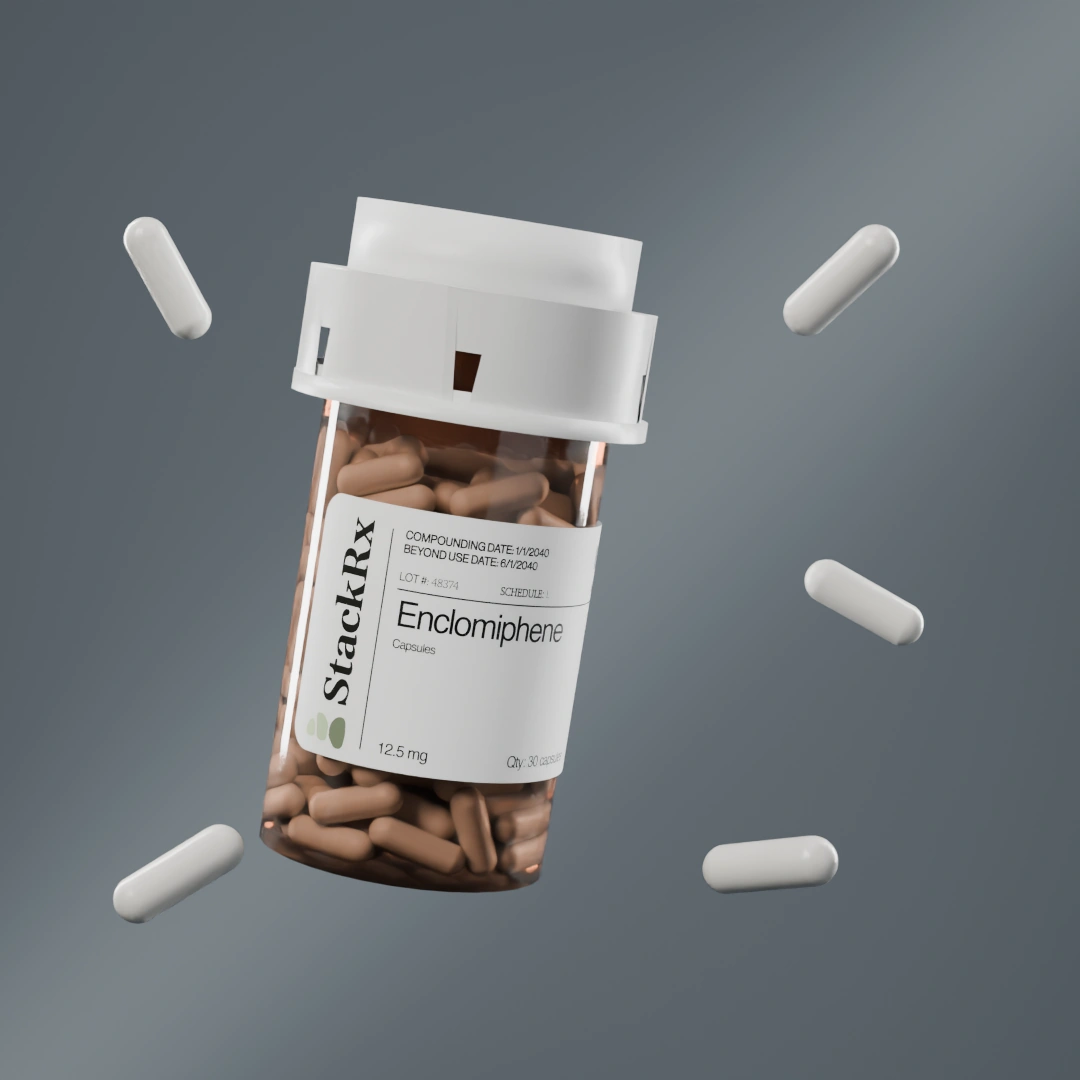
Enclomiphene vs testosterone therapy: two ways to raise testosterone
Testosterone therapy adds testosterone from outside. Enclomiphene prompts your testes to make more of their own, and it only helps some men.
In short
- Testosterone therapy adds testosterone from outside, while enclomiphene, a daily capsule, raises the brain’s signals so your testes make more of their own.
- Enclomiphene can only help men whose testes still respond, which is why bloodwork comes before any prescription.
- In 16-week trials it raised testosterone into the normal range for most men, and sperm counts held steady on average, but no trial measured how men felt.
- Testosterone therapy is the standard, FDA-approved treatment for low testosterone; enclomiphene isn’t FDA-approved, and a provider decides whether it’s right for you.
How each one raises testosterone
Your brain controls how much testosterone your testes make. The pituitary gland sends two hormone signals, LH and FSH, that tell the testes to make testosterone and sperm.
Testosterone therapy adds testosterone from outside. It comes as injections, a gel or cream, pellets under the skin, a patch, nasal gel or capsules. Your brain responds by turning down LH and FSH, so the testes make less of their own testosterone and sperm.
Enclomiphene takes the other route. It blocks estrogen’s feedback in the brain, so the pituitary releases more LH and FSH, and the testes make more testosterone. It starts at 12.5 mg a day, and your provider may adjust it to 6.25 or 25 mg based on your bloodwork. It’s one of the two forms that make up clomiphene, an older fertility drug for women. On its own, enclomiphene isn’t FDA-approved.
Because it acts through the testes, enclomiphene can only help when they can still respond and the brain’s signal is what’s weak. Testosterone therapy doesn’t rely on that signal.
| At a glance | Enclomiphene | Testosterone therapy |
|---|---|---|
| How it acts | Raises LH and FSH so the testes make more | Adds testosterone from outside |
| Your own LH and FSH | Go up | Turned down |
| Form | Daily capsule | Injections, gel or cream, pellets, patch, nasal gel or capsules |
| Needs testes that respond | Yes | No |
| Sperm counts in 16-week trials | Held steady on average | Fell on testosterone gel |
| FDA-approved for low testosterone | No | Yes |
| Long-term safety data | None | Much more |
Who enclomiphene is for, and who it isn’t
Enclomiphene is for men 18 and older with low testosterone on two morning blood tests, and LH and FSH that aren’t high. That pattern suggests the testes can still respond to a stronger signal.
It isn’t for women or anyone without testes. Men without testes can ask a doctor or urologist about options like testosterone therapy. If LH or FSH is high, the brain is already sending a strong signal, but the testes aren’t responding fully. This is called primary hypogonadism, and enclomiphene isn’t expected to help. Testosterone therapy is the usual treatment. Because it lowers sperm counts, men who want children should see a urologist who treats male infertility first.
The bloodwork
Symptoms like tiredness and a lower sex drive have many causes, so bloodwork comes first:
- Two early-morning total testosterone tests, drawn before 10 a.m. Guidelines use results below 300 ng/dL.
- LH and FSH, which show whether the brain’s signal or the testes are behind low testosterone.
- Prolactin. A high level can lower testosterone and needs looking into before any testosterone treatment.
- Hematocrit, a measure of how thick your blood is.
- PSA, if you’re 40 or older.
After you start, testosterone is rechecked at 4 to 6 weeks to set your dose, then every 6 to 12 months, along with hematocrit and, depending on your age, PSA.
In a large study of men aged 40 to 79, low testosterone with symptoms affected about 2 in 100 men. A lower sex drive, fewer morning erections and erection trouble were the symptoms most tied to it. Tiredness, low mood and weight changes are real, but they’re more often caused by sleep, stress, weight or mood.
What the research shows, and where it stops
What it shows. In two 16-week trials of 256 overweight men aged 18 to 60 with low testosterone, average testosterone rose from about 205 ng/dL to the low 400s on enclomiphene. In two other trials, with results posted but not published, about 8 in 10 men reached normal testosterone.
Sperm counts. In the 16-week trials, sperm counts held steady on average on enclomiphene. On testosterone gel, average counts fell by about a third to more than half. But averages hide a spread. In the unpublished trials, 14% of men on enclomiphene had sperm counts drop by half or more, against 3 to 4% on placebo. No study has looked at pregnancies, so enclomiphene can’t be said to protect fertility. If having children matters to you, ask your provider about a semen analysis before you start, so you have a baseline.
What it doesn’t show. The trials measured testosterone levels, not how men felt. Energy, sex drive, erections, mood and quality of life weren’t measured, including on testosterone gel. A 48-week study found no difference in lean muscle compared with placebo. The trials were short, run by the drug’s maker and mostly in men with obesity, and they didn’t use compounded capsules. There’s no long-term safety data on the heart, blood clots or the eyes.
So enclomiphene can raise testosterone in men like those studied. Whether that changes how you feel hasn’t been shown.
If you’re on testosterone now
Please don’t stop testosterone on your own. Stopping suddenly can leave you with very low testosterone for weeks or months while your body restarts its own. The longer you’ve taken it, the longer that usually takes.
Bloodwork taken on testosterone can’t show how you’d respond to enclomiphene, because testosterone switches off the LH and FSH signals enclomiphene relies on. The enclomiphene trials left out men who’d used testosterone in the past 6 months. So a provider plans any switch with you: when to stop, what to expect in between, and when to test. Don’t take both unless your provider intends it. The same goes for hCG, anastrozole and clomiphene, which act on the same hormone system.
If a doctor has offered you testosterone therapy, it’s the standard, FDA-approved treatment for low testosterone. If children are part of your plans, tell whoever prescribes it.
FDA status and how it’s made
Enclomiphene isn’t an FDA-approved drug. An application to approve it was turned down in 2015. It’s compounded: a licensed pharmacy prepares it for you individually, under an FDA policy that currently allows compounding it while the FDA reviews it. That policy isn’t an approval, and it can end. The FDA doesn’t review compounded medicines for safety, effectiveness or quality. Read more about compounded vs FDA-approved medicines.
Safety and who shouldn’t use it
Side effects
The most common are headache, hot flashes, nausea, dizziness and mood changes like irritability, anxiety or low mood. Muscle spasms have been reported too. They often ease. Enclomiphene can also raise estradiol, hematocrit and PSA, which is why your provider checks your bloodwork. In safety data from 490 men, 3 had blood clots: 2 in a leg and 1 in a lung. Blurred vision led some men to stop.
Stop enclomiphene and get medical help right away for:
- vision changes, such as blurring, spots or flashes
- pain or swelling in one leg
- chest pain
- sudden shortness of breath
Who shouldn’t use it
Enclomiphene usually isn’t used with:
- high LH or FSH, or testes that don’t make testosterone
- liver disease
- a pituitary tumor or other brain lesion
- thyroid or adrenal problems that aren’t under control
- a past blood clot or a clotting disorder
- prostate or breast cancer, now or in the past
- a high hematocrit
Tell your provider first about:
- testosterone or other hormone treatments in the past 6 months
- cataracts or a past blocked vein in the eye
- trying to conceive now
- kidney disease
- a heart attack, stroke or heart failure
- depression, anxiety or trouble with anger
- paroxetine, fluoxetine or bupropion, which can raise enclomiphene levels
ED medicines like sildenafil and tadalafil are generally fine with it. Some rules apply to anything that raises testosterone. Hormone-sensitive cancers usually rule it out, and a high hematocrit or PSA needs follow-up first. The enclomiphene trials enrolled men aged 18 to 60, so there’s less information for older men.
StackRx visits aren’t open yet. When they open, a US-licensed provider will review your answers and bloodwork, and prescribe enclomiphene only if it’s right for you. See all hormone treatments.
Sources
- Kim et al., BJU Int 2016, enclomiphene phase 3 trials ZA-304/305 (16 weeks, 256 overweight men aged 18 to 60; testosterone from about 205 ng/dL to 413 to 446 ng/dL; sperm counts vs testosterone gel), PubMed 26496621
- Enclomiphene trials ZA-301/302, results posted on ClinicalTrials.gov, unpublished (about 80% reached normal testosterone; 14% had a 50% or greater drop in sperm concentration vs 3 to 4% on placebo)
- Enclomiphene trial ZA-205 (48 weeks; lean mass not different from placebo) and ZA-300 safety data (490 men; 2 blood clots in a leg and 1 in a lung; dropouts for blurred vision, headache and aggression)
- European Male Aging Study: Wu et al., NEJM 2010 (men aged 40 to 79; symptomatic low testosterone in 2.1%), PubMed 20554979
- AUA Testosterone Deficiency Guideline 2018, reaffirmed 2024 (two early-morning tests below 300 ng/dL; LH, FSH, prolactin and PSA), auanet.org
- Clomid (clomiphene citrate) label (liver disease, thyroid or adrenal problems, vision changes), DailyMed
- Repros Therapeutics press release on the Androxal (enclomiphene) complete response letter, December 1, 2015
- FDA, interim 503A bulks policy (January 2025), fda.gov; 503A categories list, May 14, 2026 (enclomiphene citrate in Category 1), fda.gov
This article is general information, not medical advice. Only a US-licensed provider who reviews your health can say whether a treatment is right for you. If you have a medical emergency, call 911.