NAD+ injection vs nasal spray: what we know, and what we don’t
One goes under the skin and one goes in your nose. How much NAD+ either one delivers hasn’t been measured, and neither has been tested for energy or aging.
In short
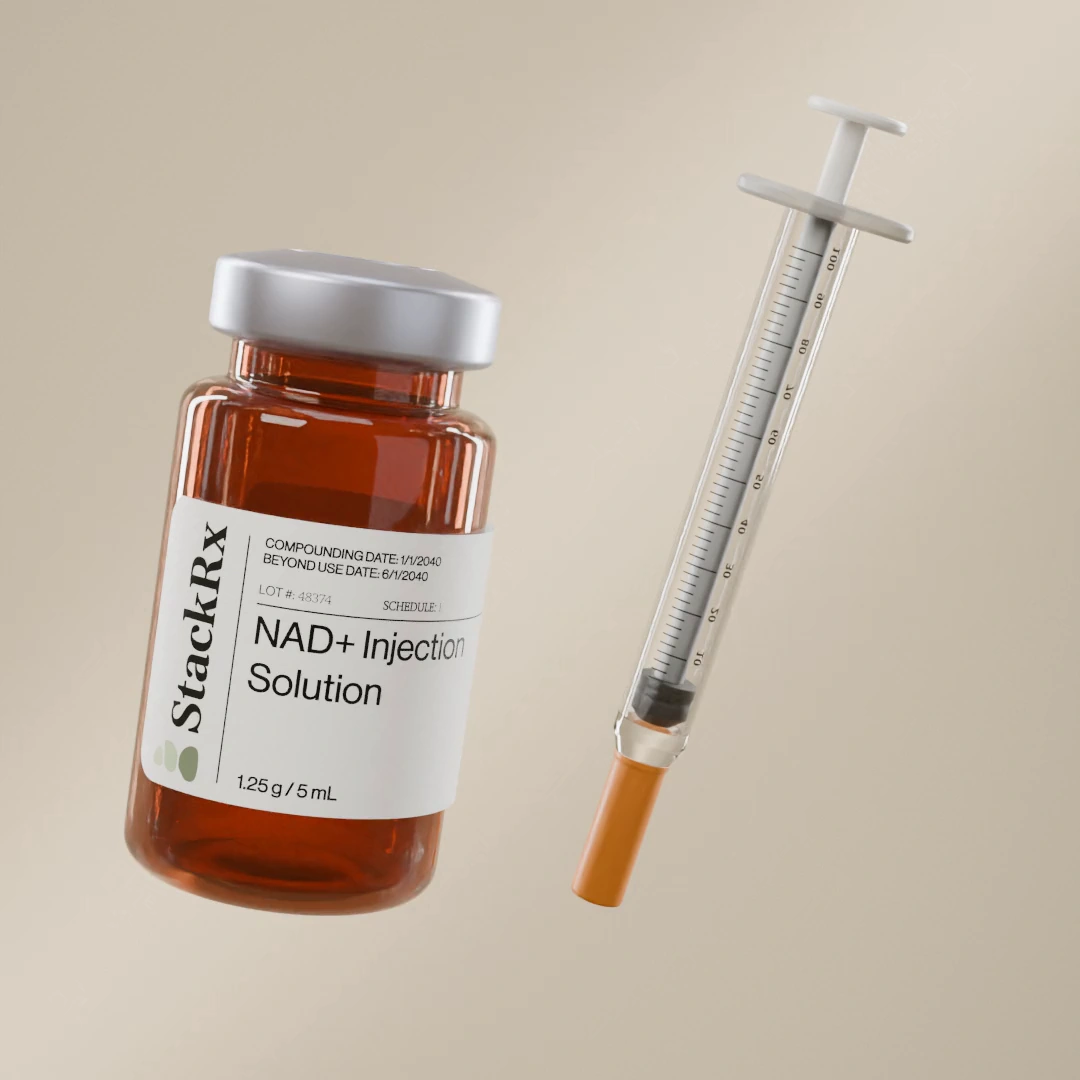
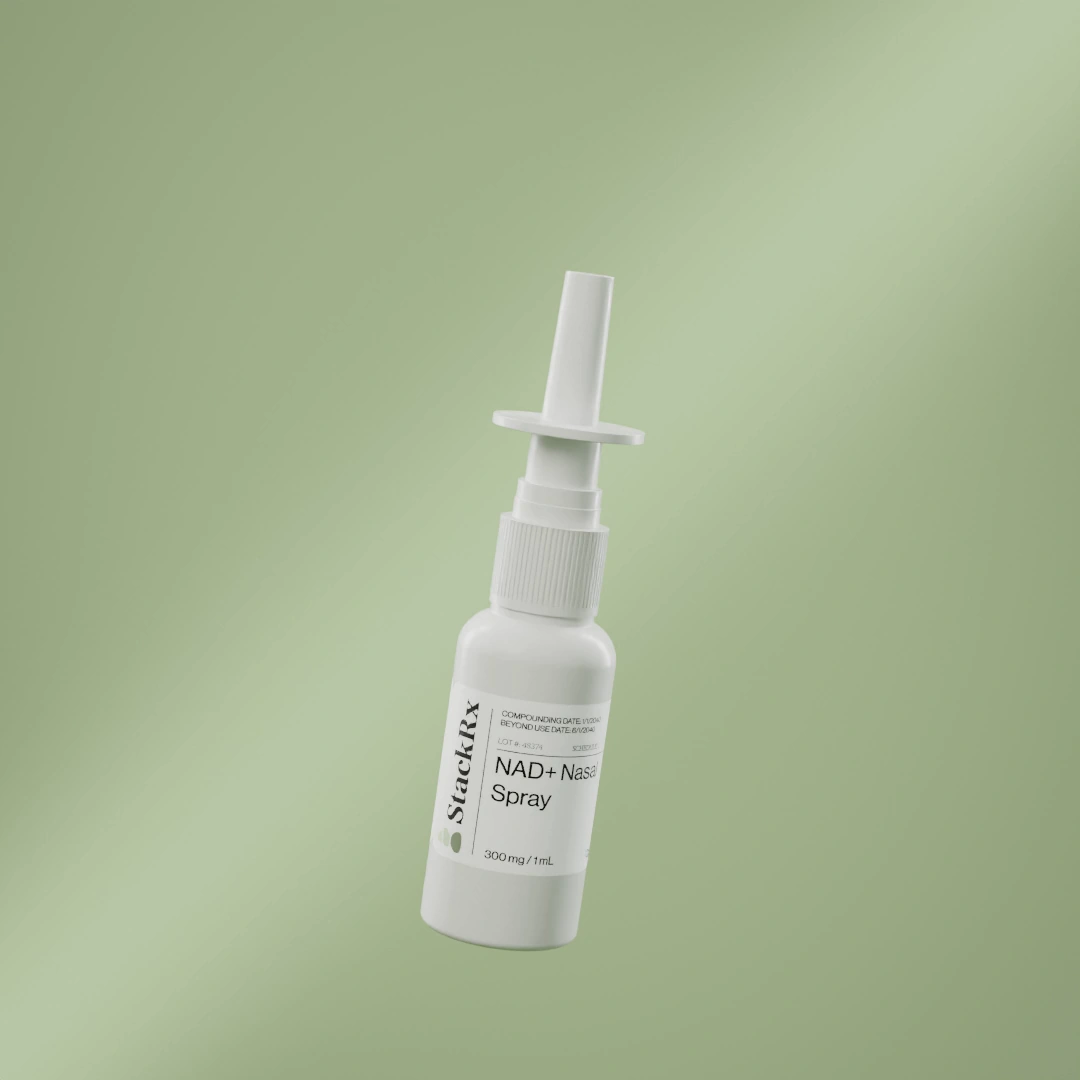
- NAD+ Injection goes under the skin a few times a week, and NAD+ Nasal Spray goes into your nose every day, with no needles.
- How much NAD+ your body absorbs from either one hasn’t been measured in peer-reviewed studies in people.
- No trial has tested either one for energy, focus or healthy aging, so each is an experiment, not a proven treatment.
- Both are compounded and not FDA-approved, and a provider decides whether either one is right for you.
What NAD+ is, and the idea behind it
NAD+ (nicotinamide adenine dinucleotide) is a coenzyme found in every cell. Your cells use it to turn food into energy and to repair DNA.
Studies of muscle, skin and brain tissue find lower NAD+ levels in older adults than in younger ones. That’s the idea behind taking extra NAD+. But no study in people has shown that adding NAD+ changes how you feel or how you age.
Pills called NR and NMN reliably raise NAD+ levels in the blood. NAD+ Injection and NAD+ Nasal Spray contain NAD+ itself.
How each one is used
For either one, your provider sets the dose, usually starting low.
The injection uses a short, thin needle, like those used for insulin. You inject slowly under the skin of your belly or thigh, a few times a week. Most people describe a pinch. Injecting slowly is the main way to avoid the warm, flushed feeling some people get.
The spray is a metered pump that you prime before the first use. Tilt your head slightly forward, aim toward the outer side of your nose, away from the middle, and breathe in gently rather than sniffing hard. Your provider sets how many sprays you use each day.
| At a glance | NAD+ Injection | NAD+ Nasal Spray |
|---|---|---|
| How it goes in | Under the skin of your belly or thigh | Sprayed into each nostril |
| How often | A few times a week | Every day |
| Strength | 1.25 g in a 5 mL vial | 300 mg per mL, 15 mL pump |
| Absorption measured in people | No peer-reviewed data | No published data |
| Common side effects | Flushing, nausea, headache, redness where you inject | Stinging, runny nose, sneezing, bitter taste, headache |
| FDA-approved | No | No |
Absorption: what’s known and what isn’t
This is the biggest open question for both. No peer-reviewed study has measured how much NAD+ reaches your blood after an injection under the skin, or after a nasal spray in people. So neither route is proven to deliver more than the other.
The injection
When NAD+ is given by IV drip, going in fast causes cramping, nausea and chest pressure. An injection under the skin is a smaller dose, absorbed much more slowly, so it may feel different if you’ve had drips before.
The spray
The inside of your nose has a good blood supply, and some medicines are absorbed well from it. But NAD+ is a fairly large, electrically charged molecule, the kind that tends to cross the lining of the nose less easily. And much of any nasal spray is carried to the back of your throat within minutes and swallowed. If your nose is often blocked, even more may run down your throat.
You may read that a nasal spray carries NAD+ straight to the brain. In rats, NAD+ given in the nose did raise NAD+ in the brain. In people, whether nasal sprays reach the brain directly is still debated, and it hasn’t been measured for NAD+.
What the research shows, and where it stops
What it shows. NR and NMN pills reliably raise NAD+ in the blood, and NAD+ given in the nose raised brain NAD+ in rats. In small, short studies of NAD+ injections, people had some discomfort but no serious safety problems. The main report is a 2026 preprint that hasn’t been peer-reviewed, and its sponsor sells a competing product.
What it doesn’t show. A 2023 review of 25 trials of NR found few effects that mattered clinically. A 2024 review of 10 randomized trials of NMN, with 437 people, found mixed results. Most trials of these pills found small or no effects on tiredness, thinking, fitness or metabolism. No trial has tested NAD+ injections or nasal spray for energy, focus or healthy aging, and no study has compared them with the pills. There’s no evidence that NAD+ slows aging in people.
So each product is an experiment, not a proven treatment. Some people feel a difference and some don’t. With no trial to set a timeline, a simple before-and-after check helps: rate a typical day from 0 to 10 before you start, then again after a couple of months, and go over it with your provider. Stopping is a fine result if nothing has changed.
How a provider chooses between them
StackRx visits aren’t open yet. When they open, a US-licensed provider will decide whether NAD+ makes sense for you at all, and if so, which route. Since neither is proven better, your preferences and your health both matter:
- Needles. The spray has none. Needle worry is common: in one review, 16% of adult patients had avoided a flu shot because of it.
- How often. The injection is a few times a week. The spray is every day.
- Your nose. Frequent nosebleeds, a hole in the septum, recent nose surgery or a nose that’s often blocked can make the injection a better fit. Other nose sprays need spacing apart from NAD+, and a cold should clear before you start.
- Blood thinners. Expect a little more bruising where you inject. With a daily spray, nosebleeds may be more likely and last longer.
Your provider will also look for other causes of tiredness or brain fog, such as short sleep, sleep apnea, low iron, thyroid problems, low B12, low mood and medicines. NAD+ wouldn’t fix those. Weight loss without trying, night sweats or memory that keeps getting worse need a checkup first. Changing routes later takes your provider and a new prescription.
Safety, side effects and who shouldn’t use it
Side effects
With the injection, the most common are warmth or flushing, nausea, headache, lightheadedness, and redness or soreness where you inject. They depend on dose and speed, which is why you start low and push the plunger slowly.
With the spray, people most often report stinging or irritation in the nose, a runny nose, sneezing, a bitter taste and headache. Nosebleeds can happen with any daily nose spray, and aiming away from the middle of your nose helps prevent them. No trial has measured the side effects of NAD+ nasal spray.
Long-term safety hasn’t been studied for either route. Tell your care team about any side effect, and get emergency care for chest pain, trouble breathing, or swelling of your face, lips or throat.
Who shouldn’t use it, or needs a visit first
- NAD+ isn’t prescribed to anyone under 18, or to anyone pregnant or trying to conceive. It hasn’t been studied in pregnancy.
- A provider should talk with you first if you’re breastfeeding or had a baby in the past year, have heart, kidney or liver disease, or have reacted to NAD+, niacin or a preservative before.
- The same goes for active cancer or cancer treatment in the past 5 years. A mouse study raised concerns about NR, one of the NAD+ pills, and the spread of breast cancer. There’s no human evidence either way.
- For the spray, a provider should also check first if you have frequent nosebleeds or a hole in your septum, had nose or sinus surgery or a broken nose in the past 3 months, or snorted drugs in the past year.
FDA status and how it’s made
NAD+ isn’t FDA-approved to treat any condition, and there’s no FDA-approved NAD+ nasal spray. Both products are compounded: a licensed pharmacy prepares them for you individually. The FDA doesn’t review compounded medicines for safety, effectiveness or quality, and it has warned pharmacies against using food-grade NAD+ in sterile products. NAD+ breaks down with heat and light, so store it exactly as the label says. Read more about compounded vs FDA-approved medicines, or see all longevity treatments.
Sources
- Damgaard & Treebak, Sci Adv 2023 (review of 25 NR trials: few clinically relevant effects), science.org
- NMN systematic review 2024 (10 RCTs, 437 people: mixed), PubMed 39221308
- SC and IM injections of NAD+ and NR, preliminary safety, medRxiv April 2026 (preprint, not peer-reviewed; sponsor sells NR), medRxiv
- IV NAD+ vs NR tolerability, real-world: Frontiers in Aging 2026, frontiersin.org
- Intranasal NAD+ in a rat stroke model (Ying lab), Front Biosci 2007, imrpress.com
- Intranasal NAD+ after traumatic brain injury in rats: Won et al., J Neurotrauma 2012, doi.org
- Mucociliary clearance and nasal spray absorption, PLOS One 2021, journals.plos.org
- Large-molecule uptake and size in nasal absorption, PubMed 10837585
- Can nasal drug delivery bypass the blood-brain barrier? Merkus & van den Berg 2007, PubMed 17472409
- Optimal technique for corticosteroid nasal spray, AAFP 2016, aafp.org
- Fear of needles, systematic review and meta-analysis: McLenon & Rogers, J Adv Nurs 2019, wiley.com
- NR and triple-negative breast cancer spread in mice (University of Missouri, 2022), Pharmacy Times
- FDA on food-grade NAD+ in sterile compounding, Partnership for Safe Medicines
- FDA Pharmacy Compounding Advisory Committee briefing document on NAD (breakdown with heat, pH and light), regulations.gov
This article is general information, not medical advice. Only a US-licensed provider who reviews your health can say whether a treatment is right for you. If you have a medical emergency, call 911.