Methylene blue: what the research shows, and the safety rules
Some providers prescribe low-dose capsules off-label for mood and focus. Here’s what small trials found, where they stop, and the rules that come with it.
In short
- Methylene blue is FDA-approved as an injection given in a hospital for a rare blood disorder, but capsules aren’t FDA-approved, and using it for mood or focus is off-label.
- In small trials in people with bipolar disorder, 195 to 300 mg a day eased depression more than 15 mg, but no trial has tested low-dose capsules for mood, focus or energy in people without a mood disorder.
- Blue or green urine is expected, and the most common side effects in studies were nausea, diarrhea, headache and a burning feeling when you pee.
- With many antidepressants, opioids and “DM” cough medicines, it can cause serotonin syndrome, so a provider reviews everything you take before deciding whether it’s right for you.
What methylene blue is
Methylene blue is a blue dye that’s been used as a medicine since the 1890s. Today it’s FDA-approved as an injection, given in a hospital to treat methemoglobinemia, a rare blood disorder.
Some providers also prescribe low-dose capsules off-label for mood and focus. Off-label means for a use the FDA hasn’t approved. Methylene blue capsules aren’t FDA-approved.
In the body, it blocks MAO-A, an enzyme that breaks down serotonin. That’s why it doesn’t mix with many antidepressants. In lab studies, it can also pass electrons along the chain that mitochondria use to make energy. Whether that matters at low doses in people hasn’t been shown.
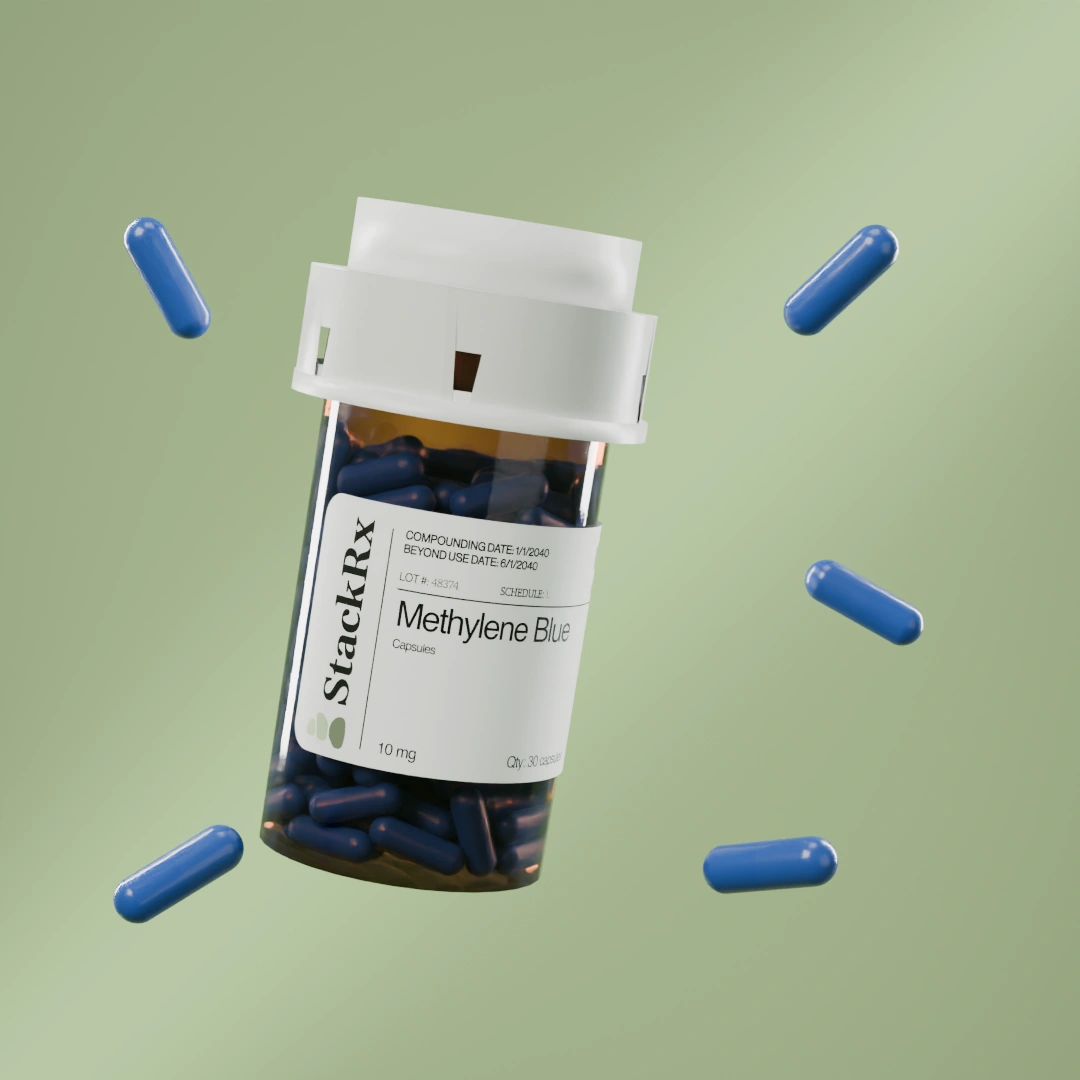
Methylene Blue is a daily capsule of pharmaceutical-grade (USP) methylene blue. The strength is usually 5 to 25 mg, and your provider sets the dose. It’s usually taken once a day with a meal. It’s compounded: a licensed pharmacy prepares it for you individually. The FDA doesn’t review compounded medicines for safety, effectiveness or quality. For more, read compounded vs FDA-approved medicines.
What the research shows, and where it stops
The evidence is limited. The mood trials were small, and most were in people with bipolar disorder who took methylene blue on top of their usual treatment.
Mood
In a 2017 trial, 37 people with bipolar disorder who were taking lamotrigine spent 3 months on 195 mg a day and 3 months on 15 mg a day. Of those, 27 finished. On 195 mg, depression and anxiety scores fell more than on 15 mg, a moderate effect. Memory and thinking didn’t improve.
In a 1986 trial, 31 people with bipolar disorder who were taking lithium spent a year on 300 mg a day and a year on 15 mg a day. Only 17 finished. They had less depression on 300 mg.
Memory and focus
In a 2016 study of 26 healthy adults aged 22 to 62, one 280 mg dose led to 7% more right answers on a short-term memory test an hour later, compared with a placebo. It made no difference on an attention test. That was one large dose, not daily use.
| Study | Who took part | Dose tested | What it found |
|---|---|---|---|
| 1986 trial | 31 people with bipolar disorder taking lithium; 17 finished | 300 mg vs 15 mg a day, 1 year each | Less depression on 300 mg |
| 1987 trial | People with severe depression | 15 mg a day vs a placebo, 3 weeks | The only placebo test of 15 mg; not repeated |
| 2016 study | 26 healthy adults aged 22 to 62 | One 280 mg dose vs a placebo | 7% more right answers on a memory test; no change in attention |
| 2017 trial | 37 people with bipolar disorder taking lamotrigine; 27 finished | 195 mg vs 15 mg a day, 3 months each | Lower depression and anxiety scores on 195 mg; no change in memory or thinking |
| Low-dose capsules | No trial in people without a mood disorder | Usually 5 to 25 mg a day | Not tested for mood, focus or energy |
Where the evidence stops
- The benefits came at 195 to 300 mg a day. In both bipolar trials, 15 mg a day, close to low-dose capsules, was the comparison.
- Only one brief trial, from 1987, tested 15 mg a day against a placebo, in severe depression. It hasn’t been repeated.
- No trial has tested low-dose capsules for mood, focus or energy in people without a mood disorder.
- Methylene blue isn’t proven to treat depression, and it isn’t a replacement for mental health care.
So low-dose methylene blue is an experiment, not a proven treatment.
Side effects, and when to get help
Expect blue or green urine, and sometimes a blue tint to your tongue or stool. It’s harmless and fades after you stop.
In studies, the most common side effects were nausea, diarrhea, headache and a burning feeling when you pee. They were usually mild and brief. Some people feel dizzy or confused or have blurry vision, so don’t drive until you know how it affects you. It can also make your skin more sensitive to sunlight, so protect your skin from the sun.
Get emergency care for signs of serotonin syndrome:
- confusion or agitation
- a racing heart
- fever or heavy sweating
- shaking, muscle twitching or stiffness
Also get care right away for chest pain, trouble breathing, swelling of your face, lips or throat, hives, or yellow skin or eyes with unusual tiredness or shortness of breath. Tell your care team about any other side effect.
How a provider decides
StackRx visits aren’t open yet. When they open, a US-licensed provider will review your health history, medicines and allergies, and prescribe methylene blue only if it’s right for you. Because of the interaction rules below, share everything you take, including supplements.
Also tell your provider about:
- Bipolar disorder or another mood condition. Your provider will want to know your diagnosis and treatment, and to coordinate with anyone treating you.
- Kidney disease. Methylene blue leaves the body through the kidneys, so your provider reviews this first.
- Triptans, trazodone, lithium or St. John’s wort. These also affect serotonin. Your provider decides whether any of them rules it out.
- Surgery or a procedure coming up. Methylene blue can make pulse-oximeter oxygen readings falsely low, so tell the care team you take it.
Methylene blue isn’t an emergency treatment. If you’re thinking about harming yourself, call or text 988 (the Suicide & Crisis Lifeline) or call 911 right away.
Safety and who shouldn’t use it
The serotonin syndrome rule
Because methylene blue blocks MAO-A, serotonin can build up when it’s taken with other medicines that raise serotonin. That can cause serotonin syndrome, which can be fatal. The FDA label for the injection carries a boxed warning about this, and the FDA warned about the combination in 2011.
Never take methylene blue with:
- an SSRI antidepressant, such as sertraline (Zoloft), fluoxetine (Prozac), escitalopram (Lexapro), citalopram (Celexa) or paroxetine (Paxil)
- an SNRI antidepressant, such as venlafaxine (Effexor), duloxetine (Cymbalta) or desvenlafaxine (Pristiq)
- an MAOI, such as phenelzine (Nardil), tranylcypromine (Parnate), isocarboxazid or selegiline
- a tricyclic antidepressant, such as clomipramine or imipramine
- bupropion (Wellbutrin), buspirone (BuSpar) or mirtazapine (Remeron)
- linezolid, an antibiotic that also blocks MAO
- any opioid, including tramadol, meperidine, methadone and fentanyl
- dextromethorphan, the “DM” in many cough and cold medicines
Don’t start any of these for at least 3 days after your last capsule. Don’t stop an antidepressant on your own to take methylene blue. Stopping safely takes weeks and needs the provider who prescribed it. If you’ve recently stopped one, tell your provider when: the FDA advises waiting 2 weeks, or 5 weeks after fluoxetine.
These warnings come from methylene blue given into a vein. Whether the risk is different at low doses taken by mouth isn’t known, so the rules for capsules follow the FDA label as written. Before you start any new medicine, cough syrup or supplement, check with your provider or pharmacist.
Who shouldn’t take it
- G6PD deficiency. Methylene blue can break down red blood cells in people with this condition, so it isn’t prescribed.
- Pregnancy, trying to get pregnant or breastfeeding. Methylene blue can harm a developing baby, so it isn’t used in pregnancy or while breastfeeding.
- A past serious reaction to methylene blue or a similar dye.
- Under 18. StackRx is for adults 18 and over.
Never lab or aquarium methylene blue
Take only the capsules your pharmacy sends, never lab or aquarium methylene blue. Industrial and aquarium grades aren’t made for people and can contain heavy metals such as arsenic and lead. Prescription capsules are compounded from pharmaceutical-grade (USP) methylene blue. See all mood treatments.
Sources
- Alda 2017, Br J Psychiatry (37 people with bipolar disorder taking lamotrigine; 195 mg vs 15 mg a day, 3 months each; 27 finished; side effects mild), PubMed 27284082
- Naylor 1986, Biol Psychiatry (31 people with bipolar disorder taking lithium; 300 mg vs 15 mg a day, 1 year each; 17 finished), PubMed 3091097
- Naylor 1987, Biol Psychiatry (15 mg a day vs placebo for 3 weeks in severe depression), PubMed 3555627
- Rodriguez 2016, Radiology (26 healthy adults aged 22 to 62; one 280 mg dose, about 4 mg/kg, vs placebo; memory +7%, attention unchanged), PubMed 27351678
- ProvayBlue (methylene blue) injection prescribing information, American Regent, DailyMed 2025 (FDA-approved use; boxed warning for serotonin syndrome with serotonergic drugs and opioids; contraindicated in G6PD deficiency; may cause fetal harm; no serotonergic drugs within 72 hours of the last dose)
- FDA Drug Safety Communication, July 26, 2011, updated October 20, 2011 (serotonin syndrome with serotonergic drugs; waiting 2 weeks after stopping an antidepressant, or 5 weeks after fluoxetine)
This article is general information, not medical advice. Only a US-licensed provider who reviews your health can say whether a treatment is right for you. If you have a medical emergency, call 911.