Estrogen creams for menopause: vaginal or on the skin?
Two creams with the same two estrogens do very different jobs. Here’s what each is for, when you need a progestogen, and where the research stops.
In short
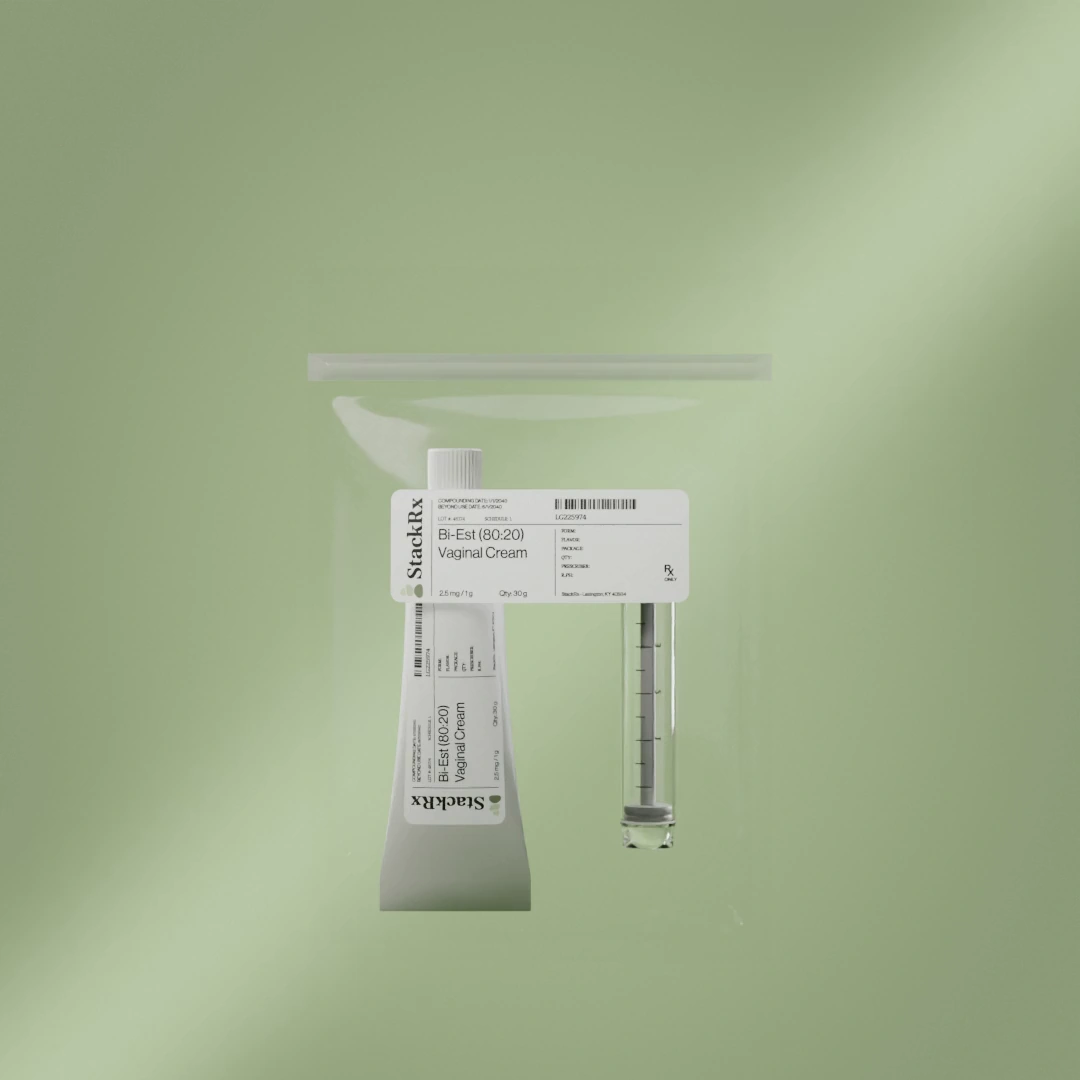
- Bi-Est Vaginal Cream is for vaginal dryness, pain with sex and bladder symptoms, and it acts mainly on nearby tissue.
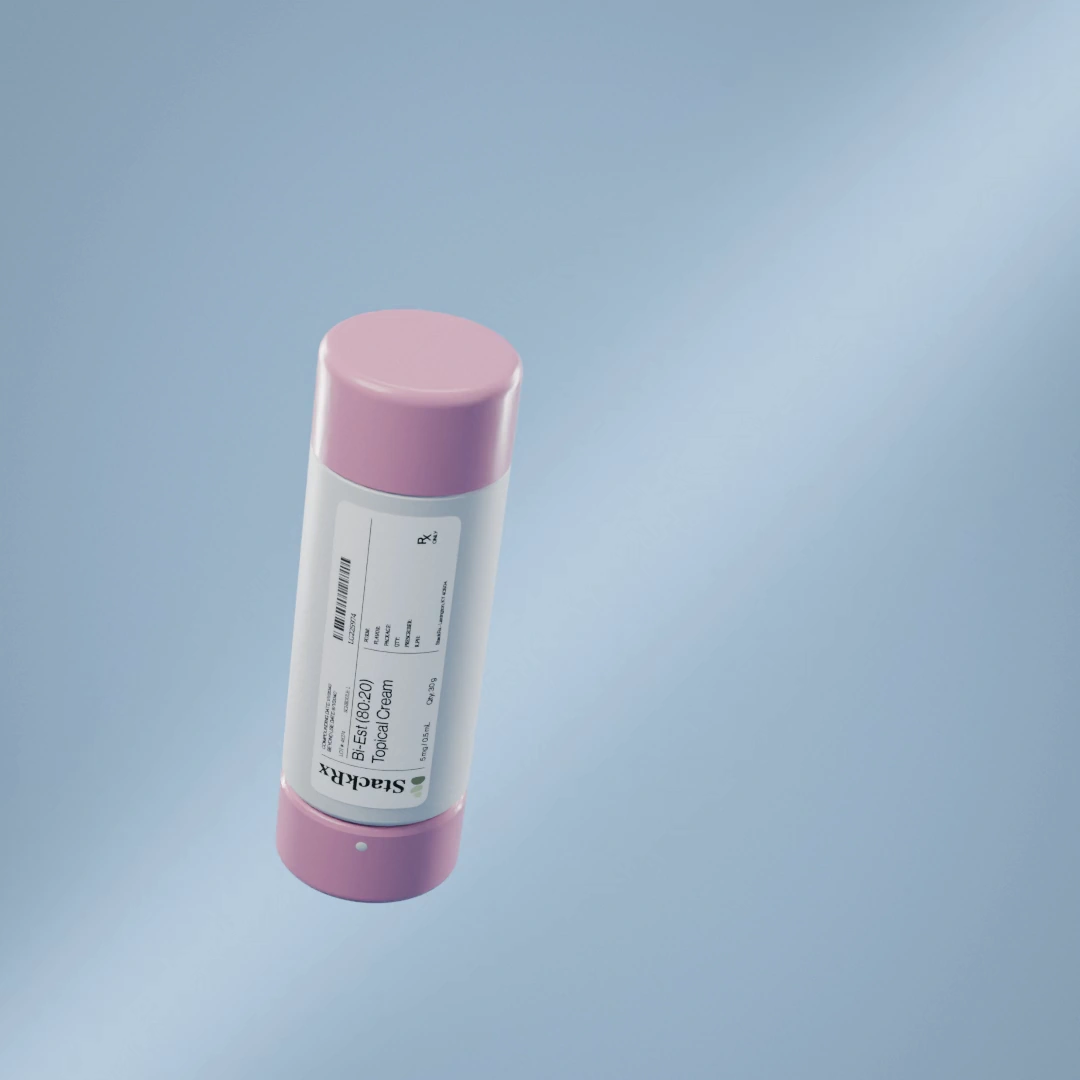
- Bi-Est Topical Cream is rubbed into the skin and absorbed into the bloodstream, for hot flashes, night sweats and other body-wide symptoms.
- If you have a uterus, estrogen on the skin must come with a prescribed progestogen, and progesterone creams don’t count.
- Both creams are compounded and not FDA-approved, no trial has tested this 80:20 blend, and a provider decides whether either is right for you.
Two creams, two different jobs
Both creams hold the same two estrogens, estriol and estradiol, in an 80:20 blend. What differs is where each goes and what it’s for.
Falling estrogen around menopause causes two kinds of symptoms. Some are body-wide, like hot flashes, night sweats and broken sleep. Others are local: the tissue of the vagina, vulva and bladder opening gets thinner and drier. Doctors call this genitourinary syndrome of menopause, or GSM.
| Compare | Bi-Est Vaginal Cream | Bi-Est Topical Cream |
|---|---|---|
| Mainly for | Dryness, irritation, pain with sex, bladder symptoms | Hot flashes, night sweats and other body-wide symptoms |
| How it’s used | Inside the vagina, with an applicator, at bedtime | Rubbed into the inner arm or thigh, once a day |
| Where it acts | Mainly nearby tissue; some reaches the bloodstream | Throughout the body |
| If you have a uterus | Your provider decides whether you need a progestogen | A prescribed progestogen is required |
| FDA status | Compounded, not FDA-approved | Compounded, not FDA-approved |
The vaginal cream: for tissue changes
After menopause, the lining of the vagina gets thinner, drier and less stretchy, and it loses the healthy bacteria that protect it. That can mean dryness, itching, pain with sex, urgency or repeat bladder infections. Unlike hot flashes, these changes don’t fade with time.
Bi-Est Vaginal Cream is placed inside the vagina with a reusable applicator. A common pattern is every night for the first couple of weeks, then 2 or 3 nights a week, as your provider sets. It isn’t a lubricant, so on nights you plan to have sex, use it afterward.
Each gram holds 0.5 mg estradiol and 2 mg estriol. That’s five times the estradiol in a gram of FDA-approved estradiol vaginal cream.
The topical cream: for hot flashes and night sweats
Bi-Est Topical Cream is rubbed into clean, dry skin on the inner arm or thigh once a day. The estrogen passes through the skin into the bloodstream and acts throughout the body. Each click of the dispenser gives the same amount of cream, but how much estrogen your skin absorbs varies. Your provider sets the strength and the number of clicks.
If your only symptoms are vaginal or bladder symptoms, The Menopause Society recommends a vaginal treatment rather than estrogen for the whole body. If vaginal symptoms remain after about 3 months on the topical cream, a provider may add a vaginal estrogen and plan the total dose together.
The progestogen rule
Estrogen makes the lining of the uterus grow. Without a progestogen, estrogen that acts on the whole body raises the risk of overgrowth of the lining and endometrial cancer, more so with higher doses and longer use.
- Topical cream, with a uterus: use it only with a progestogen your provider prescribes, such as progesterone capsules. It’s a separate prescription. FDA-approved labels for body-wide estrogen used alone carry a boxed warning about cancer of the uterine lining.
- Progesterone creams don’t count. Neither store-bought nor prescription progesterone creams have been shown to protect the lining.
- No uterus: if your uterus and cervix have been removed, you don’t need a progestogen.
- Vaginal cream: in 20 trials of low-dose vaginal estrogen with 2,983 women, overgrowth of the lining showed up in 0.4%, about the usual rate. Those data come from low doses, and this cream is stronger per gram than FDA-approved estradiol cream, so your provider decides whether you need a progestogen with it.
What the research shows, and where it stops
Vaginal estrogen
In a review of 30 trials with 6,235 women, estrogen creams, tablets and rings eased dryness and other symptoms more than a placebo, with no clear difference between them. In a trial of 167 women, a low-dose estriol gel eased dryness more than a placebo gel over 12 weeks. In a trial of 93 women with repeat bladder infections, those using estriol cream had 0.5 infections a year, against 5.9 on placebo.
Estrogen for hot flashes
In 24 trials with 3,329 women, estrogen taken as pills cut hot flashes by about 75% compared with placebo; creams like this one haven’t been tested that way. In a large UK study, estrogen through the skin, as FDA-approved patches and gels, wasn’t linked to blood clots, unlike pills.
The studies of compounded creams measured estrogen levels, not symptoms. In a 16-day study of 40 women, Bi-Est 80:20 creams gave lower estradiol levels than a standard patch. In lab records of 1,062 women, compounded estradiol creams gave lower levels than gels and patches at similar doses.
What hasn’t been tested
No trial has tested this 80:20 blend, as a vaginal cream or on the skin, or looked at its effects on clots, stroke, breast cancer or the uterus. Estriol isn’t in any FDA-approved US product.
Both creams are compounded, and the FDA doesn’t review compounded medicines for safety, effectiveness or quality. A 2020 National Academies report found little good evidence on the safety or effectiveness of compounded “bioidentical” hormones, and “bioidentical” doesn’t mean safer. FDA-approved estradiol creams, tablets, rings, patches, gels and sprays are available, and your provider may recommend one instead. See compounded vs FDA-approved medicines.
Safety and who shouldn’t use them
A provider reviews your health history before prescribing either cream, and prescribes only if it’s right for you.
- Both creams: don’t use them if you’re pregnant. Bleeding after menopause needs to be checked before you start, and any vaginal bleeding while you use them should be reported. Keep up with mammograms.
- Vaginal cream: common side effects include burning, itching, discharge, spotting, breast tenderness, headache, bloating and yeast infections. Some estrogen reaches the bloodstream, and how much the risks of estrogen pills apply at this strength isn’t known. Use only the amount your provider sets. After breast or another hormone-sensitive cancer, a clot, stroke, heart attack, clotting disorder or liver disease, use it only after a clinician has gone over that history with you.
- Topical cream: common side effects include breast tenderness, spotting, headache, bloating, nausea and skin irritation. Less common but serious: clots, stroke, heart attack, gallbladder disease, higher blood pressure and breast cancer. Breast cancer, a past clot, stroke or heart attack, a clotting disorder, unexplained bleeding and active liver disease usually rule it out. Starting at 60 or later, or more than 10 years after menopause, carries more risk.
- Treated skin: let it dry, wash your hands and cover it with clothing. Children, partners and pets can absorb estrogen from it.
- Also: the topical cream isn’t birth control. Tell your provider before surgery or long bed rest, as it may need to stop 4 to 6 weeks before. Keep up with blood pressure checks.
Get care right away for chest pain, a painful or swollen leg, sudden shortness of breath, a sudden severe headache, changes in vision or speech, weakness or numbness on one side, or swelling of the face, lips or tongue. More on both creams is on the hormones page.
Sources
- Lethaby et al., Cochrane Database Syst Rev 2016 (30 trials, 6,235 women)
- Constantine et al., Menopause 2019 (20 trials, 2,983 women)
- Cano et al., Menopause 2012 (167 women, 12 weeks)
- Raz & Stamm, N Engl J Med 1993 (93 women with recurrent UTIs)
- MacLennan et al., Cochrane Database Syst Rev 2004 (24 trials, 3,329 women)
- Vinogradova et al., BMJ 2019 (estrogen route and blood clots)
- Sood et al., Maturitas 2013 (40 women, 16 days)
- Newman et al., Menopause 2023 (1,062 women)
- The Menopause Society, 2020 GSM and 2022 hormone therapy position statements
- British Menopause Society, progestogens and endometrial protection; Climacteric 2016 systematic review of progesterone and the endometrium
- Estradiol vaginal cream 0.01% and estradiol gel (Divigel, 2026) prescribing information
- FDA announcements on menopausal hormone therapy labeling, November 2025 and February 2026; FDA 2010 communication on Evamist exposure in children and pets
- National Academies of Sciences, Engineering, and Medicine 2020 report on compounded bioidentical hormones; ACOG Clinical Consensus 6 (2023)
This article is general information, not medical advice. Only a US-licensed provider who reviews your health can say whether a treatment is right for you. If you have a medical emergency, call 911.